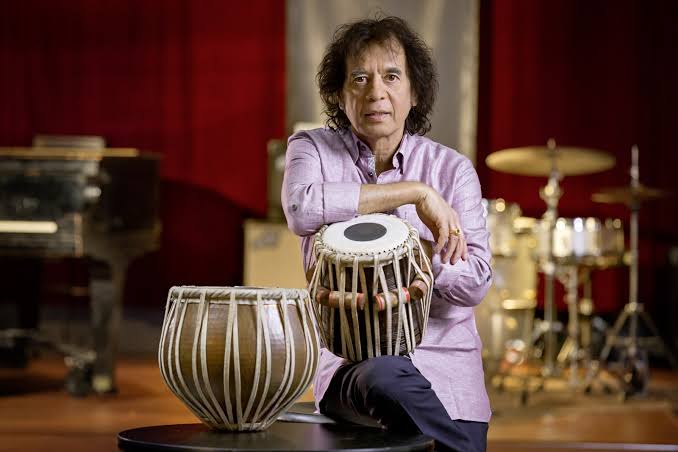
Today marks the first death anniversary of Ustad Zakir Hussain, one of the greatest tabla maestros the world has ever seen. Zakir ji was not only a virtuoso tabla player, but a guiding force who shaped how rhythm was understood, respected, and carried forward in Indian Classical, as well as World Music.
For many of us, our first encounter with his music happened before we even knew what tabla bols were. His sound reached us through radio broadcasts, Doordarshan concerts, cassette tapes, hushed conversations between gurus and shishyas, and later through platforms like YouTube and Spotify. There was clarity in his playing, but also warmth. Discipline, but never rigidity. It was a rhythm that was a complete literature in itself.
Born Into the Guru Shishya Parampara
Ustad Zakir Hussain was born on 9 March 1951 in Mumbai, into a household where music was not a profession but a way of living. As the son of Ustad Alla Rakha, one of the most revered tabla accompanists in Hindustani classical music, his initiation followed the strict traditions of the guru shishya parampara. His first lessons were not written or explained. They were absorbed through listening, observation, and relentless riyaaz.
Ustad Zakir Hussain with his father and guru, Ustad Allarakha
Zakirji once said, “I did not choose the tabla. The tabla chose me.” This statement reflected the inevitability of a life shaped by discipline, inheritance, and surrender to art.
By his teenage years, he was already performing internationally. Yet senior musicians noticed something rare. His playing never rushed to prove itself. He listened deeply, responded sensitively, and treated accompaniment as a sacred responsibility.
Redefining the Role of the Tabla in Indian Classical Music
Traditionally, the tabla player supports the melodic artist. Zakirji embraced this role fully, yet expanded its emotional and musical possibilities. His accompaniment felt conversational, never overpowering, yet impossible to ignore. He made the tabla a thinking, responding voice rather than a timekeeping tool.
Ustad Zakir Hussain accompanying Pt Rakesh Chaurasia
As a soloist, he redefined how tabla could be presented to both Indian and global audiences. His tabla solos were not displays of speed alone. They were carefully structured narratives built on clarity, layakari, and aesthetics.
Taking Indian Rhythm to the World
Ustad Zakir Hussain’s global influence was not the result of dilution or fusion for novelty. His collaborations with Pt Ravi Shankar, Pt Shivkumar Sharma, John McLaughlin, Mickey Hart, and others were grounded in mutual respect for musical grammar.
Through projects like Shakti, he demonstrated that Indian rhythm could converse with jazz and Western classical traditions without losing its identity. His performances abroad did not simplify Indian classical music. Instead, they invited listeners to meet it at its own depth.He always said, “When I play with musicians from other cultures, I don’t try to copy their music. I try to be deeply Indian, while having an understanding of their music.” This unwavering rootedness is what made his music resonate across cultures.
Shakti’s NPR Tiny Desk Concert
A Guru Beyond Classrooms
Ustad Zakir Hussain was a teacher even without a formal classroom. His interviews felt like masterclasses. His stage conversations felt like gentle lessons in aesthetics and humility. He emphasized listening over display, discipline over shortcuts, and respect over fame.
He believed that music education was about shaping sensitivity, not just technique. Many musicians who never formally studied under him still consider him their guru. In Indian classical tradition, inspiration itself can be a form of lineage.
Ustad Zakir Hussain at Talks at Google
Awards, Recognition, and Musical Responsibility
Over his lifetime, Ustadji received India’s highest civilian honours, including the Sangeet Natak Akademi Award, Padma Shri, Padma Bhushan, and Padma Vibhushan, the Kyoto Prize, along with multiple Grammy Awards and international recognitions. Yet he rarely spoke of achievements. Instead, he spoke of the responsibility that comes with these achievements.
Ustad Zakir Hussain received the Kyoto Prize in 2022
Every performance, he believed, represented not just the artist, but the tradition itself. This sense of accountability kept his music honest, even while being experimental.
Remembering Ustad Zakir Hussain
Tribute to Ustad Zakir Hussain
With the passing of Ustad Zakir Hussain, Indian classical music did not lose only a tabla maestro, but also a bridge between generations, between cultures, and between discipline and freedom.
Yet what he leaves behind is enduring. He leaves behind a philosophy where rhythm is not mechanical, but human. Where tradition is not preserved by isolation, but by sincere engagement. Where innovation grows naturally from deep roots.
As musicians observe his first death anniversary, sitting with our instruments and counting familiar taals, we realise something quietly profound. His hands may no longer touch the tabla, but his sense of time continues to shape ours.
Ustad Zakir Hussain taught us that rhythm is not something you play. It is something you become.