If you’ve ever listened to a tabla solo or a Kathak performance and felt something pulse deeper than the beats themselves, you’ve already felt what taal truly is. In Indian classical music, taal is often translated as rhythm or time cycle. But that translation barely scratches the surface. Taal is not just about keeping time, it’s about living inside rhythm, breathing with it, and letting it shape your musical consciousness.
What Taal Really Means
The word taal comes from the Sanskrit root tāl, meaning “clap.” In the early days, keeping rhythm simply meant clapping to mark time. But over centuries, the concept grew into something far more profound.
Taal represents a cycle of beats, each cycle returning to its starting point, called the sam. This return is not mechanical, but symbolic. It mirrors the Indian way of seeing time as a circle, not a straight line, like the cycles of day and night, birth and death, creation and dissolution.
When musicians play within a taal, they aren’t marching forward through time; they’re moving through it like waves, always coming back to the shore.
Beyond Counting: Feeling the Pulse
In the beginning, every student counts the beats : one, two, three, four. But as they grow, they stop counting and start feeling. The great percussion masters say that taal should be felt in your breath, not just in your fingers.
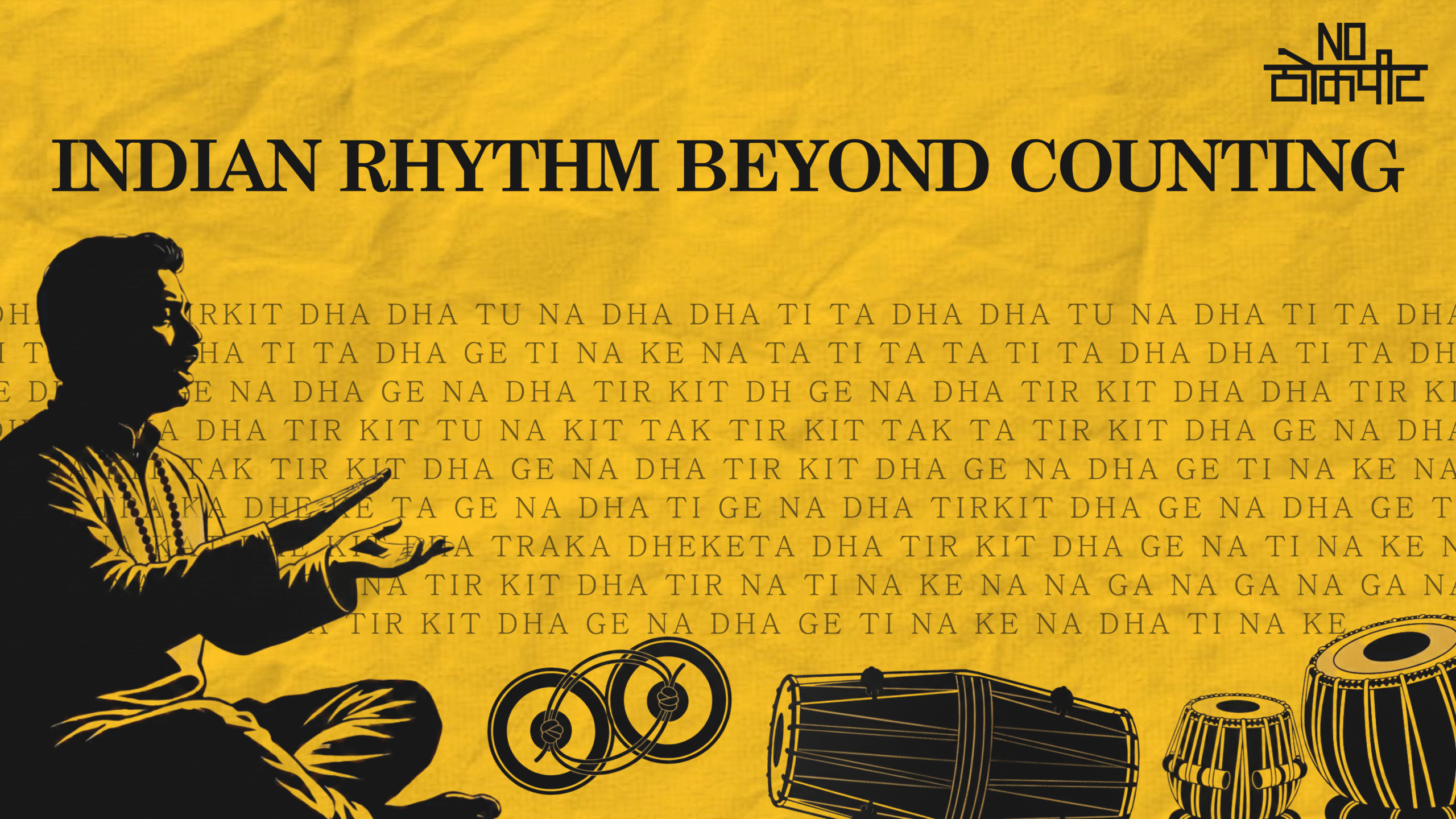
This is why tabla players recite bols : syllables like dha, dhin, na, ti. These aren’t random sounds; they’re the spoken language of rhythm. When a player recites dha dhin dhin dha, they’re training the body and mind to internalize rhythm beyond numbers.
As you advance, the counting disappears, but the awareness deepens. You no longer “keep” the rhythm, but become part of it.
Listen to Pt. Yogesh Samsi’s lecture on Importance of Padhant
The Inner Structure: Sam, Khali, and Vibhag
Every taal has its own grammar. Let’s take Teentaal, perhaps the most famous of all. It has 16 beats, divided into four equal sections, or vibhags. The first beat is the sam, the point of arrival. The ninth beat is khali, the “empty” beat, a moment of silence and suspension.
This constant dance between fullness (sam) and emptiness (khali) gives taal its heartbeat. It’s almost like breathing in and out, expansion and rest.
Carnatic music has a similar system of talas like Adi Tala or Rupaka Tala, where each beat and section has meaning. The structure is mathematical, yes, but its purpose is deeply expressive.
Taal and Theka: The Cycle and Its Voice
In Indian classical music, taal and theka are closely related, yet they represent two distinct ideas.
Taal is the rhythmic framework, or the abstract cycle of beats (matras) that defines the structure of a composition. For example, Teentaal has 16 beats divided into four equal sections. It is a concept, a blueprint that organizes rhythm and time.
Theka, on the other hand, is the spoken and played pattern that brings that taal to life. It is the language of rhythm, expressed through tabla bols like dha dhin dhin dha. Theka gives personality and texture to the otherwise abstract structure of the taal.
To put it simply:
- Taal is the cycle, the skeleton.
- Theka is the expression, the flesh and character.
Every taal can have its own theka, and skilled percussionists often vary the theka while keeping the taal intact. This interplay between form and improvisation is what makes Indian rhythm so dynamic. The taal holds the space, and the theka fills it with sound, emotion, and movement.
Understand the difference and relation between Taal and Theka
A Conversation Between Melody and Rhythm
In Hindustani music, one of the key parts of the repertoire is the dialogue between the melodic and the rhythmic elements. The tabla doesn’t just keep time, it speaks to the main artist. When a vocalist or instrumentalist finishes a phrase, the percussionist responds, weaving patterns that both support and challenge the melody.
The moment when both return together to the sam is electric. It’s a shared moment of resolution, almost spiritual. That’s why musicians often smile or nod when they land perfectly on the sam after a long improvisation. It’s not just coordination; it’s connection.
Taal as a Reflection of Life
Every taal carries its own personality. Jhaptal feels restless and dynamic. Rupak feels playful. Dadra is often gentle and lyrical. Just like human emotions, each taal expresses a different state of being.
In Indian thought, rhythm is not separate from life. The universe itself is seen as a rhythmic vibration, the Nada Brahma, the sound that created the world. Playing within a taal is, in a way, aligning yourself with that cosmic rhythm.
Pandit Kishan Maharaj once said, “Taal is not something you play, it is something you live.”
Why It Matters in Today’s World
In an era where music is often quantized to grids and loops, taal reminds us that rhythm is alive. It’s not about perfection, but balance. It breathes, stretches, and swings, just like a heartbeat.
For musicians, learning taal isn’t only about mastering time signatures. It teaches how to listen, how to wait, and how to respond. It cultivates patience, intuition, and flow, qualities that go far beyond music.
In the End
Taal is more than a cycle of beats. It’s the heartbeat of Indian music, a meeting point of math, feeling, and spirit. When you truly understand taal, you stop counting time and start experiencing it. You realize that rhythm isn’t outside you; it’s already there, echoing within your pulse, waiting to be awakened.