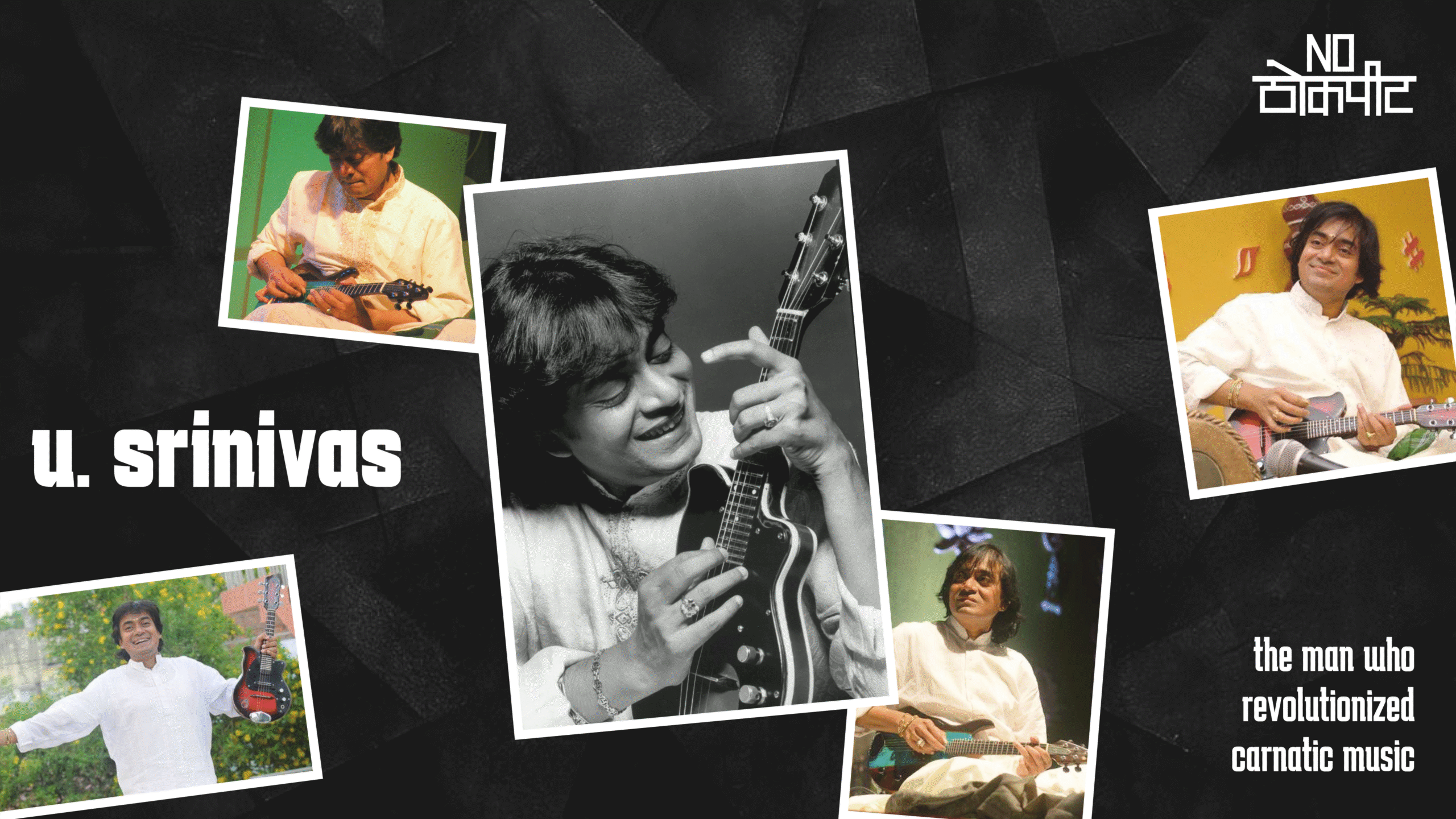
When people speak of innovation in Carnatic music, one name definitely rises: U. Srinivas. Known globally as Mandolin Srinivas, he transformed a Western instrument into a powerful voice of Indian classical tradition. His journey from a child prodigy to international icon reshaped the landscape of South Indian Classical Music.
This is the story of how U. Srinivas redefined the mandolin in Carnatic music and built a legacy that continues to inspire musicians across the world.
Early Life of U. Srinivas: A Child Prodigy is Born
Uppalapu Srinivas was born on February 28, 1969, in Palakollu, Andhra Pradesh. Raised in a musical family, he began learning music under the guidance of his father, U. Satyanarayana, who recognized his extraordinary talent early on.
At the age of five, Srinivas started playing the mandolin, a Western instrument rarely associated with Indian classical music. At a time when Carnatic concerts featured vocalists, violinists, flautists, and veena artists, the mandolin was virtually unheard of in this tradition.
But Srinivas saw possibilities where others saw limitations.
How U. Srinivas Adapted the Mandolin for Carnatic Music
One of the most remarkable aspects of U. Srinivas’ musical journey was his technical innovation. To make the mandolin suitable for Carnatic ragas, he modified the electric mandolin by adjusting the string configurations. He adapted tuning to suit Carnatic scales and mastered intricate gamakas and microtonal nuances.
Carnatic music demands expressive slides and oscillations. Srinivas developed a unique playing technique that allowed the mandolin to reproduce these complex elements with stunning clarity.
By the age of nine, he had already given his first public performance. Audiences were captivated not just by his speed but by the depth and maturity in his raga alapana.
Rise to Fame, Global Recognition and Fusion Collaborations
He made his debut public Carnatic concert performance in 1978 during the Thyagaraja Aradhana festival at Gudivada in Andhra Pradesh. Thereafter, at age eleven, in 1981, he gave his first public concert in Chennai at the Indian Fine Arts Society during the December Music Season.
U. Srinivas was not confined to the Carnatic stage. His musical curiosity led him to collaborate internationally, most notably with guitarist John McLaughlin in the band Remember Shakti.
Through such collaborations, Srinivas brought Carnatic music to global audiences, positioning the mandolin as a serious classical instrument rather than a novelty.
His performances at international festivals helped bridge Indian classical music and world music traditions, expanding the reach of Carnatic ragas beyond India.
Awards and Honors
U. Srinivas received numerous accolades for his contribution to Indian classical music. Among the most significant was the Padma Shri, awarded when he was just 29 years old, making him one of the youngest classical musicians to receive this honor.
His achievements cemented his reputation as one of the greatest Carnatic instrumentalist in history.
Contribution of U. Srinivas to Carnatic Music
The contribution of U. Srinivas to Carnatic music can be understood in three major ways:
1. Instrumental Innovation
He permanently established the electric mandolin in the Carnatic concert format.
2. Technical Evolution
He developed new fingering techniques to execute gamakas authentically.
3. Global Expansion
He carried Carnatic music to international audiences, making it accessible and respected worldwide.
Today, many young musicians experiment with non-traditional instruments in Indian classical music. That confidence traces back to U. Srinivas.
Legacy and Untimely Passing
U. Srinivas passed away on September 19, 2014, at the age of 45. His untimely death left a profound void in the world of Indian classical music.
Yet his recordings continue to serve as masterclasses.
Each performance reflects both discipline and devotion, blending mathematical precision with emotional intensity.
He proved that tradition is not rigid. It evolves through courage and imagination.
U. Srinivas redefined the mandolin for Carnatic music and ensured that its voice would resonate for generations to come. 🎶