
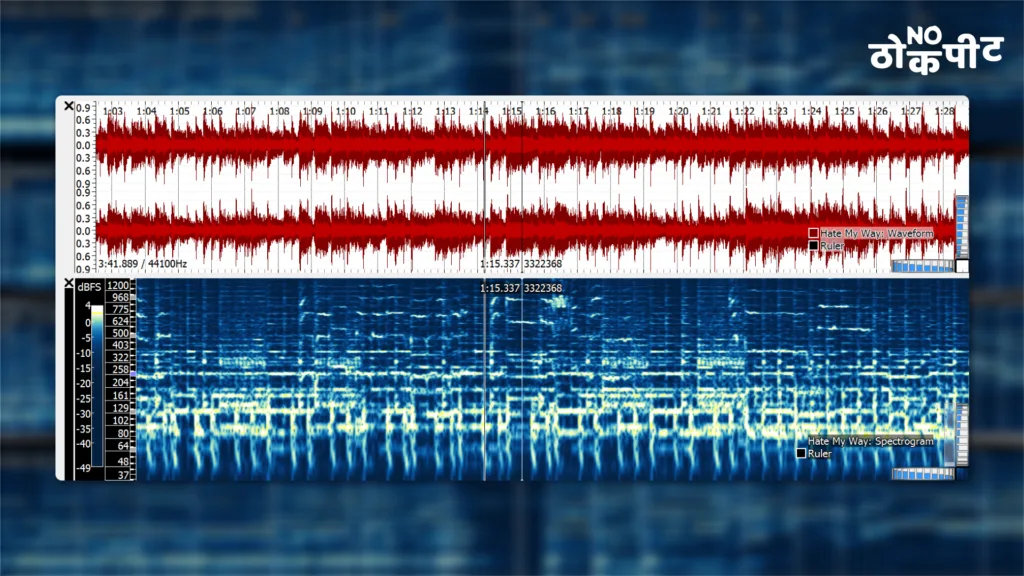
Raga recognition comes easily to a seasoned listener: play a few phrases of Raga Yaman and they will often name it within seconds, from the way the notes move as much as from the notes themselves. Teaching a computer to do the same, known as automatic raga recognition, has kept researchers busy for years, and a study published on 30 April 2026 shows how far the work has come.
A team from four Hyderabad institutions, with Rathan Kumar Chenoori of Keshav Memorial Institute of Technology as first author, built a dataset of about 15,000 Hindustani clips, roughly 500 hours of music across 32 ragas. Their model scored 92.4% on its own test set, measured as an F1 score, which balances correct answers against misses, and between 88% and 90% on recordings from two outside collections it had never heard.
What is raga recognition?
Raga recognition is the task of identifying which raga a piece of music is in, straight from an audio recording. It is hard for a computer because a raga is more than a scale: two ragas can share the same notes and still differ in how phrases move, which notes are stressed, and how each note is ornamented.
What the machine listens for
The Hyderabad team did not stop at right or wrong answers. They used explainability tools, Grad-CAM++ and SoundLIME, to show which moments in a recording pushed the model towards its answer. It is the same question an earlier study from IIT Kanpur asked in 2024: do these models hear a raga the way trained listeners do? That study, by Parampreet Singh and Vipul Arora, worked with 191 hours of Hindustani recordings across 12 ragas.
The 2026 system also adds a teaching layer. Once it names a raga, it gathers background from the web, including the raga’s history, its mood or rasa, and well-known pieces in it, so a student gets context along with the answer.
Why raga recognition matters for listeners and archives
Archives across India hold thousands of hours of concert recordings with little or no labelling. Reliable raga recognition could make them searchable, help students test their own ears, and help streaming services file classical tracks properly. A 2025 review from Amrita Vishwa Vidyapeetham, which compared the classifiers used in earlier studies, described the field as still at an early stage. And no model yet hears everything a trained listener does.
Raga recognition tools you can try today
There is no Shazam for ragas yet, and the systems in these studies are not public apps. But a few tools already let you do parts of the job yourself.
- Find a raga from the notes you hear: Carnatic Raga (free, iPhone). Tap in the swaras you can pick out and it lists the ragas that use them, from more than 950, with their arohanam and avarohanam.
- See a melody the way the models do: Sonic Visualiser (free, Windows, Mac and Linux), from Queen Mary University of London. Open a recording in Sonic Visualiser and add the Melodia melody-extraction plugin from the Music Technology Group in Barcelona, and it draws the pitch curve of the main voice, so you can see the gamakas and meends that set apart two ragas with the same notes.
- Check your own singing against a raga: NaadSadhana (free with in-app purchases, iPhone and iPad), built by the Pune vocalist and software engineer Sandeep Ranade. Choose a raga and it follows your pitch as you sing, showing when a note is on or off, with tanpura and tabla accompaniment.
- For researchers and developers: the CompMusic raga datasets (free), from the Music Technology Group in Barcelona. The Indian Art Music Raga Recognition Dataset holds 480 Carnatic recordings in 40 ragas and 300 Hindustani recordings in 30 ragas, with pitch and tonic data, the kind of material raga recognition studies are built on.
Your own ear is still the best tool of all. Train it with our Raga of the Week, read about another new idea in the music, the Gajveena, and browse our Innovation news.
Sources: Chenoori et al., “Automated Raga Identification System with Web Scraping Framework”, ISI journal, IIETA (30 April 2026, open access); Singh and Arora, “Explainable Deep Learning Analysis for Raga Identification in Indian Art Music”, arXiv (2024); Amrita Vishwa Vidyapeetham, comparative study of AI classifiers (2025); Carnatic Raga, App Store page; mirdata, CompMusic raga dataset description; Hinduism Today, on NaadSadhana (2021, background)