
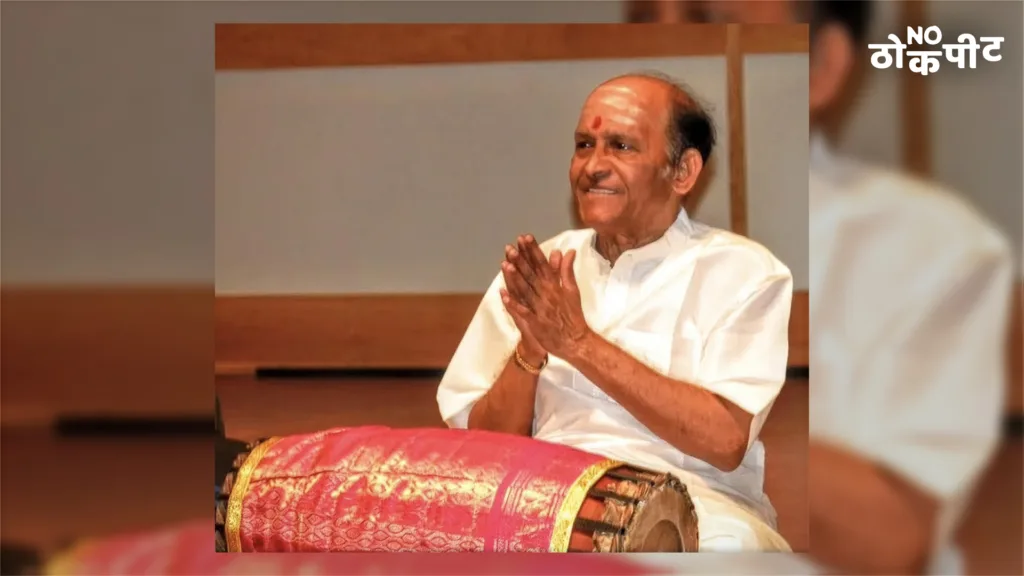
Guruvayur Dorai, the mridangam artist who first sat on a concert stage at the age of eight, beside the singer Chembai Vaidyanatha Bhagavathar, died in Chennai on 10 October 2026. He was 91, and had played for nearly eight decades.
Few accompanists have played across as many eras of Carnatic music. His career began with a singer born in the 1890s and ran on into the present century, and through all of it he stayed a player other musicians trusted to hold the rhythm while they took risks.
Who was Guruvayur Dorai?
Guruvayur Dorai was a Carnatic mridangam artist and teacher, born Vaidyanathan in Guruvayur, Kerala, on 2 July 1935. An exponent of the Pudukottai style, he trained with Palani Subramania Pillai and accompanied leading vocalists and instrumentalists for nearly eight decades. His honours included the Padma Shri and the Sangeet Natak Akademi Award.
A childhood in Chembai’s company
Music was close at hand from the start. His sister, Guruvayur Ponnammal, was a well-known singer and a student of Chembai, who stayed with the family whenever he came to Guruvayur and took a keen interest in the boy’s practice. His father had set his heart on making him a mridangam player. Dorai’s first lessons were with Palghat Subba Iyer and E.P. Narayana Pisharody, and his debut, at eight, was with Chembai himself.
In 1949 he travelled to Madras, now Chennai, to play with Chembai, and the same year met the mridangam master Palani Subramania Pillai. When Pillai moved to the city in 1953, Dorai went to learn from him, and spent close to nine years living in his house in the gurukula way, absorbing the Pudukottai style from the inside.
Listeners knew Guruvayur Dorai for his gumki, the deep, ringing bass stroke of the mridangam, and for the sensitivity of his accompaniment.
A teacher whose reach went far
His teaching travelled well beyond Chennai. In May 1978 he recorded a lesson and interview at the University of Washington in Seattle, which is still kept in its ethnomusicology archive. At home in Mylapore, the Guruvayur Dorai Trust carries his name and his work forward.
Alongside the Padma Shri and the Sangeet Natak Akademi Award, Guruvayur Dorai received Tamil Nadu’s Kalaimamani and the Sangeetha Kalasikhamani. He is survived by his wife and daughter.
His absence will be felt in December 2026, when the Chennai Margazhi Music Season begins, in the halls where he played for most of his life. See our In Memoriam page for other tributes, and the News & Concerts page for the season’s listings.
Sources: Kerala Kaumudi, on his death (10 October 2026); GKToday, on his death and career (11 October 2026); Sruti cover story, issue 382 (background); University of Washington Ethnomusicology Archives, 1978 recording (background); Mylapore Times, on the Guruvayur Dorai Trust (12 December 2019, background)