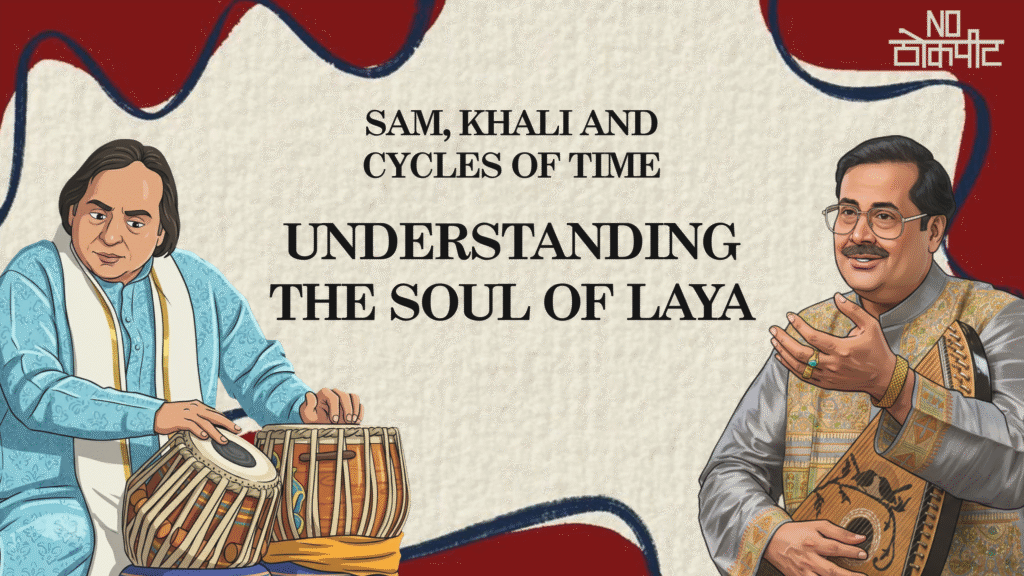
In Indian classical music, rhythm is a living pulse that shapes melody, emotion, and expression. The concepts of Sam, Khali, and the cyclic nature of time together form the soul of laya, the rhythmic flow that sustains all musical creation.
Whether it’s the graceful cycle of Drut Teentaal or the meditative expanse in the Vilambit laya, every composition in Indian music is a conversation with time itself.
Laya: The Pulse of Indian Music
Laya means tempo, flow, or the continuous movement of time in music. It’s not mechanical like a metronome, but organic and alive, breathing with the performer’s emotion.
In Indian classical tradition, laya is divided into three broad types:
- Vilambit Laya (Slow tempo): Creates space for depth and emotion.
Example: The vilambit khayal or alaap of any raga. - Madhya Laya (Medium tempo): Offers balance and clarity, ideal for bandish or gat compositions.
- Drut Laya (Fast tempo): Brings energy and excitement, often used in tukras or jhala passages.
This is not rigid categorization, but a very flexible framework that helps increase the ease of understanding and communication between musicians. Laya acts as a bridge between rhythm (taal) and melody (raag), aligning both in perfect time.
Taal: The Cycle of Time
If laya is the flow of time, taal is its structure. A taal is a rhythmic cycle of beats (matras) divided into smaller sections (vibhags).
Each section is marked by claps (taali) and waves (khali), creating a dance between sound and silence.
Example: Teentaal (16 beats)
Dha Dhin Dhin Dha | Dha Dhin Dhin Dha |
Dha Tin Tin Ta | Ta Dhin Dhin Dha |
- Total beats: 16
- Divisions: 4 vibhags of 4 beats each
- Sam: Beat 1 (the point of convergence)
- Khali: Beat 9 (the point of emptiness)
This cyclic repetition gives Indian rhythm its spiritual quality, a sense of eternal return.
Sam: The Point of Convergence
Sam (pronounced sum) is the first beat of the taal and the destination of every rhythmic journey.
It is the moment of resolution, when melody and rhythm align perfectly.
In a performance, when a musician lands exactly on sam after a complex improvisation, it evokes immense satisfaction. It’s not just accuracy, it’s alignment with time itself.
Example: Tihai Landing on Sam
A tihai (a rhythmic phrase repeated thrice) in Teentaal often aims to finish exactly on sam.
If the tihai starts on the 13th beat, its third and final phrase must resolve on beat 1 of the next cycle.That perfect landing symbolizes balance, discipline, and mastery over time.
Khali: The Beauty of Emptiness
In contrast, Khali literally means “empty.” It is the wave of the hand, a pause in energy and sound.
If sam is fullness, khali is space.
In Teentaal:
- Beats 1, 5, and 13 are taali (claps).
- Beat 9 is khali (wave).
This alternation creates contrast and relief.In Kathak dance, khali is visually shown through a wave or softer movement, representing the absence of stress or emphasis. This makes the return to sam even more powerful.
Cycles of Time: The Eternal Return
Indian taal is cyclic, it keeps returning to sam. This mirrors ancient Indian philosophy, where time is seen as cyclical rather than linear.
Every cycle in taal represents:
- Creation (the start of the cycle or sam),
- Sustenance (beats in between), and
- Dissolution (khali or pause before renewal).
Pt. Ajoy Chakrabarty speaks on how Taal, Lay and Chhand are important to understand music
The Spiritual Meaning of Laya
Ancient scriptures like the Nada Bindu Upanishad describe laya as the cosmic rhythm of the universe.
When a musician immerses in laya, they transcend the self and merge with the universal pulse of creation.
Every return to sam symbolizes oneness, while every khali represents emptiness, together forming a perfect balance, much like sound and silence, life and death, fullness and void.
Parallel Concepts Across Traditions
- Hindustani Classical: Sam and khali guide all improvisation within teentaal, ektaal, jhaptaal, etc.
- Carnatic Music: Similar ideas exist as eduppu (starting point), arudi (landing point), and kalam (tempo).
- Folk and Bhajan traditions: Bhajni Theka (8 beats) and Dadra (6 beats) maintain the same cyclic spirit of sam and khali.
This universality shows that rhythm in Indian music is not bound by style, it is a philosophy of time itself.
Conclusion: The Soul of Laya
Sam, khali, and the cycles of taal are not just rhythmic markers, they are the reflections of existence.
They teach us that time is not a line but a circle, ever-returning, ever-renewing.
To understand laya is to feel the breath of the universe, a timeless pulse that flows through every note, every silence, and every moment of being.
Watch Taalyogi Pt. Suresh Talwalkar ji’s lecture on Laya and Taal at Pt. Arvind Parikh ji’s Baithak
Further Reading
Why Taal Is More Than Time: Understanding Indian Rhythm Beyond Counting