
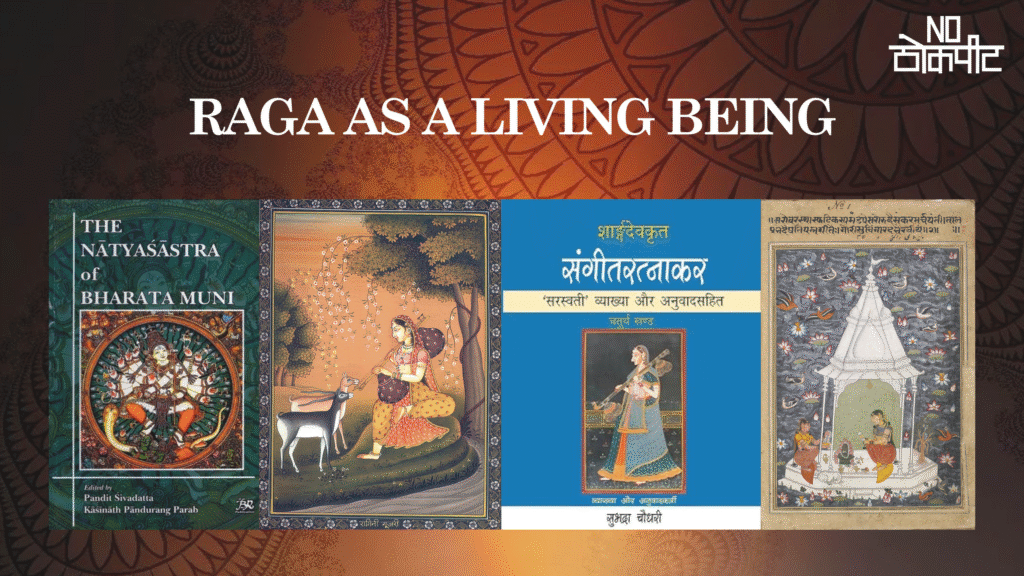
In Indian classical music, a raga is not merely a collection of notes or a melodic framework. It is a living consciousness; a being that breathes, evolves, and communicates emotion. To the trained ear and sensitive heart, a raga feels alive, capable of expressing love, longing, serenity, or even divine ecstasy. This unique philosophy, where music transcends abstraction and becomes personified, lies at the core of India’s spiritual and aesthetic heritage.
The Idea of Raga as a Living Entity
The Sanskrit word raga originates from the root “ranj”, meaning to color or to please the mind. Thus, a raga is something that colors the consciousness of both the performer and listener. In the ancient text Natyashastra by Bharata Muni, ragas were not seen as static entities but as vibrant energies associated with mood, time, and emotional state.
In medieval treatises like Sangita Ratnakara by Sharangadeva, ragas were described as having forms (rupa), moods (bhava), and personalities (prakriti). Each raga, therefore, had a distinct identity, like a person with emotions, temperament, and preferences.
What is a Raga by Pt Ravi Shankar
Raga Rupa: The Visual and Human Form of Melody
Ancient musicologists often gave each raga a visual form known as Raga Rupa or Ragini Pat. This tradition reached its artistic peak during the 16th-18th centuries, particularly in the Ragamala paintings of Rajasthan and the Deccan. These paintings depicted ragas as divine or royal figures, each adorned in symbolic attire and expressions.
For example:
- Raga Bhairav was depicted as a stern ascetic meditating at dawn, representing solemnity and devotion.
Pt Jasraj sings Raga Bhairav
- Raga Megh appeared as a dark, monsoon prince surrounded by clouds, signifying romance and the joy of rain.
Pt Rajan and Sajan Mishra perform Raga Megh at the Darbar Festival
- Raga Deepak was painted as a radiant youth holding a lamp, believed to ignite fire when performed with purity.
Ustad Ghulam Mustafa Khan performs Raga Deepak
These visual forms were not mere imagination, they expressed the raga’s inner soul, its bhava (emotion) made visible.
Personification Through Emotion: The Rasa Connection
The emotional essence of each raga is captured through the ancient Indian aesthetic theory of rasa, or flavor of emotion. A raga evokes a specific rasa, be it shringara (love), karuna (compassion), veera (heroic), or shanta (peaceful). This emotional evocation is what gives the raga life.
For instance:
- Raga Yaman carries a serene and devotional shanta rasa, often performed at dusk to evoke tranquility.
- Raga Darbari Kanada embodies the depth of karuna rasa, expressing compassion and gravity.
- Raga Desh reflects shringara in its monsoon beauty, blending romanticism and longing.
Thus, when an artist performs, they are not just playing notes, they are awakening the rasa of the raga, giving life to its spirit.
What is a Raga
The Role of Time and Season: The Rhythms of Existence
Just as living beings follow cycles of day and night, ragas are bound to the rhythm of time (Samaya Chakra) and seasons (Ritu Chakra). Certain ragas are meant for morning, some for evening, others for the rains or spring. The belief is that a raga is most “alive” when performed at its prescribed time, resonating with the natural energy of that moment.
Examples include:
- Raga Bhairav (early morning): Reflects the stillness and spiritual awakening of dawn.
- Raga Multani (afternoon): Mirrors the heat and introspection of the midday sun.
- Raga Malhar (monsoon): Brings forth the joy and rejuvenation of rain.
This deep connection with time and nature reinforces the idea that a raga breathes with the world itself.
The Performer as a Medium: Breathing Life into Sound
A raga’s true life begins when a musician invokes it through alap, bandish, and taans. The artist does not “compose” or “perform” a raga, they manifest it. This is why Indian musicians often say, “Raga aaj prakat hua” (the raga revealed itself today).
During performance, the musician becomes a vessel through which the raga’s consciousness expresses itself. When Ustad Amir Khan sang Raga Marwa, it felt like time seemed to dissolve in its introspective melancholy. When Pandit Ravi Shankar played Raga Jog, listeners could sense both playfulness and serenity as if two personalities were conversing.
This divine personification transforms performance into sadhana (spiritual practice), where the goal is not applause but revelation.
Raga as Divine Presence
In Indian spiritual philosophy, sound (Nada) is seen as the first manifestation of the divine. Nada Brahma, the concept that “the universe is sound” teaches that every vibration holds consciousness. A raga, therefore, is a sacred embodiment of this cosmic sound, carrying divine intelligence.
Saint-composers like Tyagaraja, Tansen, and Swami Haridas treated ragas as deities. They invoked them through devotion, not ego. The bhakti (devotion) and shraddha (faith) of these musicians transformed their music into a dialogue with the divine.
When Tansen sang Raga Deepak, legend says lamps lit on their own. When Swami Haridas sang Raga Megh, rain poured over Vrindavan. Whether fact or metaphor, these tales express one truth, that ragas respond to sincerity, as living beings do.
The Listener’s Role: Experiencing the Living Raga
Just as a raga awakens through the performer, it completes its journey through the listener. A sensitive listener does not merely hear the music but feels the raga’s presence. This shared space of anubhava (experience) is where the living raga truly breathes.
In a perfect performance, time stands still, and the listener feels as if they are conversing with a sentient being. The raga becomes both subject and soul, an inner friend whispering truths beyond words.
Conclusion: The Eternal Breath of Raga
To call a raga a “living being” is not poetic exaggeration, it is a spiritual truth born from centuries of tradition. A raga lives through time, season, and human emotion. It speaks through the artist, listens through the audience, and evolves with every rendition.
In this continuous cycle of birth, expression, and rebirth, ragas remind us that music is not a product, it is life itself vibrating through sound. The philosophy of personification in Indian music thus reflects the deepest Indian belief: that everything, even melody, carries a soul.